Tuesday, October 17, 2006

Uganda - Peace versus Justice!


People never really talk about Uganda as much as they did when Idi Amin was in power and terrorising the country. But today, this week, right now, there is a peace process going on in Juba in southern Sudan that is trying to end a 20 year Uganda civil war, one of the longest civil wars there has been on the African continent.

And nobody really knows anything about it.

The civil war has been fought up in the north of
Uganda between the government and a rebel group called the Lord's Resistance Army (LRA). Although the claim they are acting on behalf of an ethnic group and intend to model Uganda on a literal version of the 10 commandments, they have in fact brutalised most of the society up there. The violence has displaced more than 1.6 million people and tens of thousands of civilians have been killed or kidnapped. The LRA are on of the most notorious groups for abducting children into their armed forces, to serve as soldiers, porters, runners and the girls as wives and sex slaves for the senior officers. In 20 years of civil war no less than 25,000 children have been abducted (UN estimate) - often forced to kill their own parents so they have no way back. The LRA have also been reported for numerous human rights abuses including mass rape, massacres and mutilation (their trade mark is to cut off victims lips!).

And now peace is on the horizon as a ceasefire was negotiated in August and a comprehensive peace deal is being negotiated at this point in time. However there is one obstacle:

In 2003 the
Uganda president Museveni asked the International Criminal Court to investigate the leaders of the LRA for crimes against humanity. And last year they delivered their verdict - they issues 5 arrest warrants for the top commanders. The LRA had been willing up to this point to negotiate but now they are reluctant to come out for fear of arrest. The whole peace process could potentially collapse as a result!

Most Ugandans, amazingly, want the arrest warrants to be dropped and favour peace above justice. They do not want the long drawn out, publicised court cases which would delay having peace and perhaps even restart the fighting. They rather are willing to forgive. To that extent Museveni has offered all members of the LRA amnesty, against the orders of the ICC.

So the question is does the ICC, whose reputation is by no means certain as many powers have not endorsed it, drop its charges? What message does this send to others rebel groups and dictators - that people ultimately do not have to be brought to justice for the awful crimes they commit? That peace is more important than justice.

Yet do you condemn Uganda for another 20 years of war because you are insisting on trying certain individuals .Does one respect the wishes of the Ugandan people, those who have actually suffered and perhaps almost have a right to be angry, and allow members of the lRA amnesty? How would you arrest these people anyway since the ICC has no enforcement powers but is dependent on the good will of nation states?

Peace versus Justice - where would you come down?


Tuesday, September 12, 2006

Cluster munitions (Landmine Action)


I went to a meeting today held by Landmine Action (www.landmineaction.org) and they gave the most fascinating talk that I just had to blog something about it.

Cluster munitions are a kind of bomb/landmine that many countries, including the UK, produce and use in war zones. Try and picture this - a rocket container is launched from a plane, and inside is up to 147 sub munitions or bomblets which come flying out and arm on the way down. Each sub munition, when it detonates, breaks up into 2,000 metal fragments and in total this weapon hits an area of 90,000 sq miles (several football pitches in size someone said), killing and maiming anything in its path. It can pierce anything metal and also has a lining which sets fire to anything flammable in it's range. And then you can launch multiple rockets at a time. Quite scary!

The problem with this weapon is twofold:
  1. A large area is indiscriminately targeted - there is no distinction between civilian and combatant, no matter how much you claim the weapon is reliable and accurate.
  2. Lots of the sub munitions and fragments do not explode and are left by the warring sides for some unfortunate person (often a child) to step on them after the conflict has finished.
Conflicts where they have been used: Iraq, Afganistan, Kosovo, and most recently in Lebanon.

One guy who gave a talk had just come back from a 5 day trip in Lebanon. In Lebanon alone there are at least 100,000 unexploded sub munitions as a result of the recent war and 465 confirmed cluster bomb sites (with more to be discovered). It has very bad consequences for the locals who rushed back after the ceasefire came into place, to make sure their land wasn't taken. Many, in removing the rubble from their homes, also touched upon sub munitions . The result was burns, lost limbs, fingers and 78 deaths (of which 28 were children). The Lebanese army doesn't have enough money to remove all the munitions so it has to proritise - roads, hospitals and homes first. So sub munitions in agricultural fields will most probably stay there for at least 6 months and so families won't get their annual harvest.

Belgian has been the first country to ban the use of cluster munitions and they are hoping others, including the UK, will follow, to eventually bring about an international treaty on the subject. It will take probably about 2 years but is definately possible as long as enough public support is mobilised. The UK government has claimed they are legal under international humanitarian law as long as they strike a balance between protecting civilians and the necessity of protecting our own troops. However although coming across initially as having investigated and on that basis achieved the right balance, they then admitted to never doing any research at all on the subject.

I'm pretty much in favour of this weapon being outright banned because of its indiscriminate nature. If you want to join the petition to have it banned, please go to www.clusterbombs.org, run by handicap international. There is also more information on www.stopclustermunitions.org and www.spreadingourvalues.com.

Tuesday, August 29, 2006

Iran and its nuclear weapons program


We are currently only days away from a UN deadline for Iran to halt work on its nuclear programme (which it has claimed it will not do).

I had do a role play in my Masters course on Iran and I was interestingly enough given the role of Britain, whose role in this affair has been prominent as part of the original EU3 trying to tempt Iran with a package of economic benefits to step down from its enrichment of uranium. Our negotiations failed sadly at that stage! This begs the question of what is better - carrots or sticks!

Some other interesting points
  • Enriching uranium is only a possible route to nuclear weapons - it can be used just to help the Iranian economy which is is need of additional sources of energy. Yet sceptics say it can get fuel from other nations.
  • A fatwa against nuclear weapons has been issued by the Supreme leader Ayatollah Khamenei.
  • Could Iran make a bomb - estimates from the International Institute for Strategic Studies in London vary from between about three to five years up to about 15 years, depending on Iran's abilities and intentions. But first it would have to take the decision to go down that path. That would mean enriching uranium much more highly than it says it has done so far.
  • Iran has supposedly hid its enrichment program from the West for the past 18 years and has put a lot of it underground - suspecious or understandable given predictable reactions from the West?
  • Iran is entitled, under the Nuclear Non-Proliferation Treaty (NPT), to enrich its own fuel for civil nuclear power, under IAEA inspection.
  • Pushing the issue could mean Iran leaving the NPT and continuing its enrichment without any supervision whatsoever - Article 5 of the treaty allows for withdrawal
Currently Iran has agreed to talks to discuss an offer by the EU, supported by the United States, for trade and other concessions if it suspends the enrichment of uranium. If it doesn't suspend its enrichment by the 31st the US wants to place sanctions, whilst Russia opposes this. If we get a deadlock in the Security Council (as normally happens ), the US will probably impose bilateral sanctions, followed by Britain no doubt and perhaps Europe. Since these rarely work- who knows - they might bomb Iranian facilities with that lovely bunker buster bomb? And perhaps even intervene with ground troops, once they get Iraq more stable.

My opinion - the US claims it wants a diplomatic route and it would be wise not to embark on another very costly adventure that will only further damage its reputation in the Middle East (if it ever had one). Iran must prove itself trustworthy by confidence building measures (I don't particularly trust it). Hopefully the crisis will die down with Iran taking this package- but something about appeasing Iran doesn't really sound right to me? Could it come back to haunt us later?

Wednesday, August 23, 2006

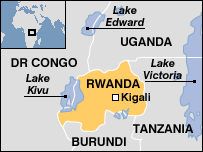
Rwanda


My disseration on Rwanda and British Foreign Policy has just been completed. An odd topic some might think since did Britain actually play any role in that crisis? The answer is yes in that they stayed inactive themselves in the fact of many warnings and also influenced UN policy to remain similarly inactive. I deliberately tried not to go around blaming everyone in the thesis but rather analysed the constraints and incentives that impact British Foreign Policy when they are deciding how to respond to such crises. I particularly compared Rwanda to Darfur today to see if anything has changed. Here are some of the points:

Political: Britain won't intervene unilaterally with troops unless there are substancial national interests involved, pressure from Parliament, sufficient political will (at home and abroad), and the support of the US and other allies.

Military: Britain will not commit troops to Africa but prefers to rely on regional troops to sort things out (yet it not forthcoming with the money to equip and train them).

Ethical: Britain claims to follow an ethical line in upholding conventions such as the Genocide Convention of 1948 and other norms of international law such as sovereignty and the responsibility to protect. In reality this is merely a justification for whatever Britain decides to do. They make the ethics fit their action as necessary.

Awareness & Knowledge: An increase in both of these help keep the government accountable via the media and general public. No government can be expected to intervene without the facts. However enough facts can be there but ignored, misinterpreted etc etc

RWANDA - Britain didn't care enough to send any troops or money or to press any one else to do the same. In fact they obstructed UN efforts in this regard. From very early on in the genocide they knew enough to realised it's nature but because it wasn't in their sphere of influence, the Americans weren't fussed and as they had higher commitments in Bosnia, it was left alone. The British have been accused of being racist towards Rwandas but this doesn't really hold much water.

DARFUR - same is happening again as in Rwanda but with a few differences. Firstly there is no denial of what is happening in Darfur as there was in Rwanda. Secondly the numbers of people killed are lower. Thirdly Britain has pledged more money but only in keeping with its interests there (oil). Action is slow - the crisis has been going on 3 years and still no UN force has gone in. Britain is not giving troops due to being overstretched with Iraq but backs the AU

Conclusion - the same constraints and incentives are at work on British Foreign Policy today as they were in 1994. A very hard and realistic line I know, but its the truth. Nations are conservative beasts and do the least possible on most occasions. The only way they would do more is if they were pressurised into it by lobby groups or things went so wrong that they had to commit more to save face. Lets hope something like that happens to help the people of Darfur.

Friday, August 04, 2006

Hezbollah versus Israel


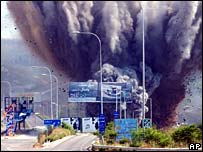
Three weeks of fighting = about 750 Lebanese people - mainly civilians - dead and half a million people are said to have fled their homes. 52 Israeli's including at least 18 civilians have been killed.

Hezbollah - resistance group/freedom fighters or terrorists? a group that began with the aim of getting rid of Israel from Lebanese territory which they achieved in May 2000. So what are they doing now? Well officially what they wanted was prisoner exchange, like what they achieved in 2000 when they exchanged the dead bodies of three Israeli soldiers they had captured for 430 Palestinians and Lebanese held in Israeli jails. Not a bad deal! It was also intended to send a warning to Israel not to conduct border raids and some sort of dramatic gesture of solidarity with the Palestinians (remember they supports the destruction of the state of Israel). They got more than they planned for it seems. They were supposed to disarm in 2004 and integrate with the army - seems they like their own autonomy to be above the law in certain things.

Israel - the victim or the aggressor? A country that is surrounded by nations hostile to its very existence and therefore takes any attacks as a kind of an attack on one is an attack on all. Paranoid some might say when it was just two soldiers kidnapped but perhaps they see it as an opportunity to resecure their boundaries with a sort of buffer zone, weaken Hezbollah and remind the surrounding nations once again that they are here to stay. The response was certainly severe - air attacks, calling up reserves, blockade of sea and air and not much regard for civilian casulties along the way. Yet is it all justified under the banner of self defence? I don't think anyone would deny Israel that right, it's just whether its a tad disproportionate to the hostile act committed, which isn't really the "act of war" Olmert says it is. But when you have a 'resistance' group on your doorstep, wishing to destroy you, with the financial backing of Syria and Iran, ready to lobb rockets right back at you with equal ferocity.........

Is either side innocent? No. Can both sides be sympathised with - to some extent yes. Is there a solution - probably not yet, only once they become war weary.

And then there's Lebanon - stuck in the middle or perhaps not? Yes its had a civil war between Muslims and Christians, its been invaded by Israel, occupied by Syria, patrolled by the UN and now has rockets flying into its capital killing its people and damaging its infrastructure. Hezbollah were elected to the Lebanese government and have some good social services running. Yet by virtue of their presence in the south, the Lebanese authorities don't have full control and they really must deal with Hezbollah - insist they integrate. Since the rockets have fallen, they have said they are 'talking' to Hezbollah to get them to stop. If rockets from Israel aren't working, why would diplomacy do any good?

And the UN - talking shop or resolver? grrr they so often just sit around and chat, bring out ambigious politically correct resolutions that please everybody, and end with 'we shall remain actively seized of the matter'. Currently haggling over the details of an international force, interestingly enough to be led by France if it happens, the resolution is going to call for an end to the violence. Is anyone going to listen? The Resolution carries the "moral authority of the UN" says the BBC. hmmm....... It may work if the US politically sits on Israel to make them stop but they might not, since who, with sufficient political clout, will sit on Hezbollah. Iran and Syria? I doubt it. But I could be proved wrong.

The conclusion of this conflict should be interesting!