Sunday, October 13, 2013
No 19 complete: Read the Pickwick Papers by Charles Dickens
An enjoyable read, even though the language and descriptions were sometimes a little hard to get through at times. Would recommend heartily!
Sunday, September 29, 2013
No 1 & 26 completed together: Portobello road market & a hummingbird cake..


Saturday, September 28, 2013
No 16 complete: Download and play music on my phone
I have now sat down and figured out how to purchase and download music to my phone. And to check it worked I bought my first three tracks for 99p each (some nice Lionel Richie etc) and had the pleasure of listening to them on my phone. Now all that I need is for my new headphones to arrive so I can listen on the go.
No 20 complete: Watch three films made in 60's and 70's
Short synopsis's below:
.Eld Cid: The fabled Spanish hero Rodrigo Diaz (a.k.a. El Cid) overcomes a family vendetta and court intrigue to defend Christian Spain against the Moors.
The Good, the Bad and the Ugly: A bounty hunting scam joins two men in an uneasy alliance against a third in a race to find a fortune in gold buried in a remote cemetery.
Friday, September 27, 2013
No 6 completed: Get a paid-for manicure

I went with my lovely cousin Amanda today to have my first ever manicure (I had a french manicure). We went to a place called Annas Touch of Beauty in Northwood and it was two manicures for £44. All really professionally done and a nice treat after being away.No 15 completed: Eat own produce
Saturday, September 07, 2013
No 7 completed: The Godfather
It was a while back but I finally watched the Godfather via Netflix. I probably learnt a lot about the film from other films because I recognised quotes such as 'go to the mattresses' and 'I'll make him an offer he can't refuse'. It was interesting to see a young Robert Duvall, an Al Pacino whom I didn't even recognise at first and Diane Keaton . I didn't really follow completely what was going on (probably because of Marlon Brando's accent) and had to read a synopsis afterwards. But it was entertaining nevertheless. Not sure I'll watch Part II or Part III though....
Monday, August 26, 2013
No 13 complete: a visit to Buckingham Palace (God Save the Queen!)
Saturday, August 17, 2013
No 23 complete: Stir fry
Monday, August 05, 2013
No 18 complete: ride in an open top car
Saturday, July 20, 2013
30 BEFORE 30
Confession: I haven't used this blog since 2007 but now i'm going to try and use it as a sort of online journal for this small project of mine '30 BEFORE 30'.
Making a list of 30 things to do before turning 30 isn't new in any sense. There loads of people who do it and so as I draw near the big 30 I thought I'd have a go BUT put a twist on it. I'm not looking to attempt feats such as jump out of a plane, learn a new instrument or head to x number of new lands because to be honest I don't have the time or the money to get it all done before then (and truth be told, I don't actually want to jump out of a plane).
But my list (below) is about ordinary every day experiences, what 30 things should I have really done by the time i'm 30 or maybe have always wanted to do in the back of my mind but for various reasons haven't got round to it. So now the motivation and deadline is set - to get them done before i'm 30! I may hear you say in surprise 'you haven't done that?' or 'you don't know how to do that?'' or even 'why do you need or want to do that'. This list is personal to me and so I can and will explain each one as I go. Some are big things that will take time, others smaller and a bit easier to do. I'm going to chart getting through each one in this blog so i can have a way of looking back on it afterwards. And I'll no doubt be relying on friends and family to help with quite a few of them in terms of knowing how to get them done. Feel free to journey with me by sending in comments, ideas and suggestions.
30 BEFORE 30 (not in any particular order)
2) Eat at Brazilian restaurant
3) Go to a Pilates class
4) Take in the view from The Shard
5) Make a Souffle
6) Get a paid-for manicure
7) Watch the Godfather
8) Learn to do three types of knots
9) Make a Baked Alaska
10) Watch a rugby match whole way through
11) Read through the whole bible
12) Learn to play Backgammon
13) Visit Buckingham palace
14) Go to Hampstead Heath
15) Eat my own produce.
16) Download and play music on my phone
17) Start a fire from scratch
18) Ride in an open top car
19) Read the Pickwick Papers by Charles Dickens
20) Watch three films made in 60's and 70's
21) Hang something up in my house (cupboard, picture etc)
22) Make my own ice cream (three interesting flavours)
23) Cook a stir fry
24) Learn two new hair styles
25) Complete three levels in French Rosetta stone
26) Go to Portobello Road market
27) Make and fly a kite
28) Take a day trip to Paris
29) Learn five different origami
Saturday, February 03, 2007
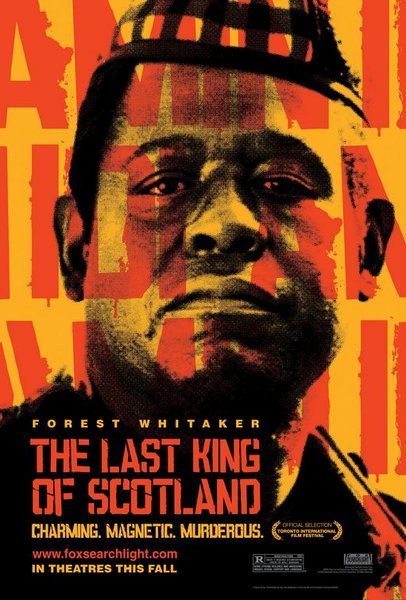
The last king of Scotland

Last week I went to see the Last King of Scotland, a 2006 British film based on Giles Foden's novel of the same name. The story revolves around how a young Scottish doctor, Nicholas Garrigan, becomes, by chance, the personal physician to the new Ugandan President Idi Amin and descends ever deeper into the moral corruption of Amin's Uganda. The main character, Dr Garrigan, is fictional but loosley based on events in the life of Amin's English-born associate Bob Astles.
Some interesting points from the film
- The charm of a dictator - the film showed how Amin charmed his way into the lives of diplomats, the press and initially his doctor. However behind the facade, he was wiping out any opposition. It was amazing how the film showed that one could be taken in and almost like him in some respects, and not face up to the reality and depth of depravity that a man could go, and how far power could corrupt.
- White man's burden - interesting point at Dr Garrigan, the main character, simply spins the globe and randomly picks Uganda to go to, without knowing background, history, being promiscious and not facing up to the realities of poverty, corruption and conflict that were present. How blind many westerners are - they go to Africa with the patronising view of being a saviour and in this case it was Dr Garrigan that ended up needing saved, by a Ugandan.
- The hypocrisy of states - the British trained Amin, welcomed and possibly helped put him in power, to then have him expel all Asians (most of whom came to Britain) and then murder his own opposition so they had to close down their embassy and condem him. So often people are put in power just to suit national interests rather than being good for the country in question.
Monday, January 15, 2007
Journalists fined over Islam joke

The BBC reported on an interesting case today from Morocco. Two journalists, Driss Ksikes and Sanaa al-Aji, have been handed sentences of three years for defaming Islam and breaching public morality. The court also banned publication of their magazine for two months and fined them about $8,000.
The two journalists had written an article entitled How Moroccans laugh at religion, sex and politics. The article had featured jokes about God, the prophets and the Moroccan king. The journalists claimed they did not invent the joke about Islam but rather used something that was already in general circulation.
So here's an interesting case study:
From the journalists point of view: they have newly-won press freedom which has been been swept away by this verdict. They claimed to make jokes was not something to be ashamed of, that making jokes did not in any way contradict with religion as there is a time for laughter and a time for seriousness, and that they were merely recording the jokes rather than inventing them. Laughter above all things, should not be suppressed as it allows a society to express itself. The journalists are backed by many international organisations and intend to appeal their sentances.
From the judges point of view: Morocco is new to freedom of press and it is fragile - therefore the prosecution argued that that there must be limits to freedom of speech, i.e that some things are better left unsaid as a mark of respect. The jokes, they claimed, deeply insulted many ordinary Moroccans and their religion. Moreover in the Koran it says there should be no image or personification of Allah and the jokes were doing just that. So the prosecution argued for Islamic traditions to be upheld and as it was, it recieved the backing of most of the Arab world.
Its interesting that one might side differently with a case such as this in Morocco compared to if such a case arose in England. In Morocco , since freedom of speech is still developing and could be so easily taken away, i would say the journalists were perhaps a bit reckless in using this joke. Even if laughter and jokes are more permissable, perhaps printed in a magazine isn't the most subtle thing to do. But then perhaps they were making a point that things had to improve more! But if this happened in England......................I wonder what would happen. One only needs to remember the cartoons published in Europe last year to imagine that if such a case arose, the outcome might be similar, except dressed up in a different wording.
Morocco - no tolerance for any religion except Islam, therefore don't mock/criticise
England - supposed tolerance for all religions, therefore don't mock/criticism
Tuesday, January 09, 2007
Rallies

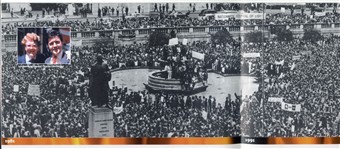
Today I attended my first rally outside Parliament - and in many ways it lived up to its definition "a large gathering of people intended to arouse enthusiasm ". This rally was not in any militant - there was some hearty chanting, singing and holding of bill boards but the numbers there were impressively large but subdued - the police presence was in the end unecessary. But it does beg a few questions regarding the use of rallies to make points (i.e are they the best option):
- Some dislike rallies because they feel it taints them - especially if extremists turn up at rallies and make their points in violent ways. Rallies have a feeling of confrontation in that people want to force the issue into the spotlight in order to make a point - some by nature of their personality, may prefer a subtler way. Does a rally mean you become labelled/sterotyped and therefore might not get so many people ready to talk to you about your cause, because of your actions?
- Others attend rallies because they want to make known the strenght of feeling regarding a particular issue and perhaps feel other methods of lobbying are ineffective - such as writing to your MP . A rally shows conviction and commitment to a cause, as you are prepared to give up time etc for something that may not have a clear/measurable outcome.
- Rallies are indeed more visual but at the same time are very hard to control - you can organise one but you can't plan who will attend and thus what kind of result you will have - rallies can end up being detrimental to organisations credibility if they turn bad.
- What matters most at a rally - many associate rallies with the noise they make or the trouble they cause - but surely it is more about the number of people that turn out to protest and the indeed the manner they conduct themselves if it is decent and peaceful.
Monday, January 01, 2007
New EU members - Bulgaria & Romania

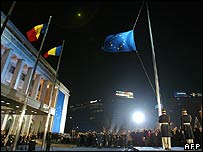
Yesterday at midnight, the countries of Bulgaria and Romania celebrated their entrance into the EU. Their accession means the EU now has 27 members and half a billion people, and stretches as far east as the Black Sea. Moreover Slovenia became the first of the group of 10 countries that joined in 2004, to adopt the euro.
The accession of the two new countries comes amid falling enthusiasm in Europe for the bloc's continuing expansion. They will now be subject to strict monitoring, to ensure they make more progress in the fight against corruption and organised crime. They face export bans on certain foods, and Bulgaria has been warned that 55 of its aircraft could be grounded unless they reach EU safety standards.There are also fears about mass immigration given that both Bulgaria and Romania are much poorer than the rest of the EU.
There is some concern in Britain with predictions on how many will come to Britain varying from 56,000 to 180,000 in the first year. However others say the accession of these two countries will be nothing compared to when 10 joined in 2004. The immigration pattern of these two countries has typically been towards the Mediterranean rather than to the north and most who wanted to come to the UK would already have done so. Regardless of this the Home Office had earlier revealed its plans to limit the right to work for Bulgarians and Romanians.
The new curbs contrast with the "open-door" policy adopted in 2004, when 15,000 migrant workers were expected to arrive each year. Instead 600,000 arrived in two years. That's Labour for you!
So the questions are:
- Will these countries be a hinderance to the EU in its bid for further unity (e.g the constitution and euro)? i.e the more states you have to accomodate, the harder it gets to rule from the centre.
- Will the fears of mass immigration prove to be a fallacy?
- Will the two new nations gain from entry into the EU - will they be buried under new EU reqirements? there are predictions that once trade barriers are down they will fail to compete and will mis spend EU aid because their institutions are too disorganised.
- Will Europe gain from having Bulgaria and Romania in the EU or will they have to be carried along?
- Who will join next and under what conditions?
Saturday, December 30, 2006
The death of Saddam Hussein

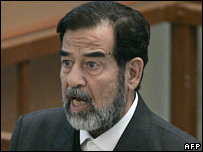
The papers this morning reported the death of Saddam Hussein, executed this morning by hanging at a secure facility in northern Baghdad for crimes against humanity. He was executed over the killings of 148 Shias from the town of Dujail in the 1980s.
The discussion in all the papers and online is - was it the right thing to do? Well certainly not according to the public that have commented on the BBC's website.
Here's a flavour of the first few pages - it was hard to find anything positive - inappropriate to execute Saddam on Eid, Saddam wasn't the only sinner in his acts, a barbaric act, disgusting act of depravity, his death will make little or no difference for the poor people of Iraq, against democratic norms and values, immoral, disgusted and ashamed, trial was extremely unfair, primitive, iraq was more secure under Saddam than under Mr Bush's occupation, A dictator created then destroyed by America, hasty and harsh, Saddam was hung a powerless old man, childish and revengeful action by Mr. Bush, murder of the legitimate Iraqi president
Some other people put the following comments that we should all consider
- Remember the families & victims who suffered under his rule
- Execution is a good lesson for those who continue to despise their own people
- Tyrant dictators across the world will sleep less easily tonight
The British public can go on about the hypocrisy of our governments, and that of the US, because they make and then break dictators, they sell arms, they take sides, they ignore conflicts and suffering when it suits and at other times moralise and interfere in the name of democracy and humanity. They will continue to do all this - nothing will change! But the British public should also watch itself - so many of the comments put online are hypocritical - they would be singing a different tune if Saddam were still in power and repressing his people. They would be calling for his removal, they would be saying the country had a right to try him how it saw fit, they would be calling for justice - and when it is delivered, albeit brutally, they complain!
And what about those that suffered - as said above i'm sure many will be relieved and feel that they have had some justice. Why do we think we have it right because we don't have the death penalty? We are so patronising and condesending to the Iraqi's about choosing this sentance for him - we call them puppets, unfair, barbaric, murderers - the poor people! They just don't seem to get anything right do they. They try their former leader, which is quite remarkable in their history to have such a trial, and yet they get criticised. If they had put him in prison they would have got criticised! If they kick the west out, they are punished, if they stay they are punished.
Whether we agree with the death penalty or not, we should all do one thing. Governments will never get everything right, in fact they get a lot wrong and actively do a lot wrong.Yet when they make a decision to rid the world of a ruthless dictator, tyrant and murderer, perhaps for once we should just respect and accept their decision.
Wednesday, December 27, 2006
War in Somalia, as of December 21st

Anyone noticed that on 21st Dec Somalia and Ethiopia formally declared war on each other and began a war of hostilities! Perhaps not because the two sides have traded war declarations on several occasions before so no one takes them seriously any more - or they just think its another african conflict and they are always at each other's throats. Somalia & Ethiopia have a long history of skirmishes in the south of Somalia over land and ethnic groups , religion, and boundaries. The same things have been fought over for years so why should now be any different!
The interim Somali government had a tiny plot of land in Somalia and yet call themselves the official government - as recognised by the UN. They are based in one small city called Baidoa, and are currently encircled by the Islamic Courts. Somalia itself is in choas with no recognized central government authority nor any other feature associated with an established independent state. And so Ethiopia sent in troops to supposedly protect the interim gov and sort things out. What a mess!
It's interesting to note a few facts that perhaps might tip the balance
- Eritrea is possibly involved (there are reports of 2,000 troops in Somalia though it denies this)- Ethiopia's long term enemy, and an ardent supporter of the Islamic Courts Union
- The West supports Ethiopia, as it seeks to support the interim government that has been set up to rival the Islamic de facto one (Islamic Courts Union). The AU has also shown sympathy for Ethiopia in that it is protecting its sovereignity.
- Ethiopia is worried about a hard line Islamic militant state on its doorstep and their claims to have rights to a portion of land in Ethiopia.
- The Islamic courts made a worldwide appeal for Muslim mujahideen to come fight for their cause and there are possible reports of 8,000 foreign fighters already in Somalia.
- Ethiopia has MiG fighter jets (where did they get those from??), 4 attack helicopters and 20 Ethiopian tanks - will that make a difference?
Questions for discussion:
- Will this fighting produce a different outcome that previously - i.e will the interim Somali government be crushed and the whole of Somalia go under Islamic Court control? What will the UN do then? Or will it merely be a war of attrition, balancing the situation out.
- Will the UN/AU send in peacekeepers - keep Black Hawk Down and the disastrous UN mission in the 90's in mind and the answer would probably be no!
Tuesday, December 26, 2006
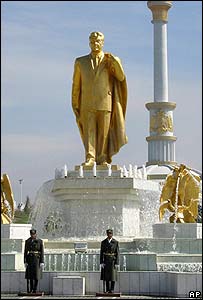
The death of a dictator in Turkmenistan

Some recent news proving worthy of discussion...............the death of longtime authoritarian leader of Turkmenistan, Saparmurat Niyazov, aged 66, whose death was announced Thursday 21st Dec after he had an apparent heart attack overnight. He left no clear successor.
Thus ends the life of idiosyncratic and iron-fisted dictator, who was so full of himself its quite unbelievable. As well as naming numerous towns, schools and even months and days of the week after himself, he then proceeded to erect numrous statues of himself (and his mother) including a gold-plated statue atop Aşgabat's largest building, that rotates 360 degrees every 24 hours so as to always face the sun and shine light onto the capital city. A bizzare personality cult indeed!
He leaves behind him a society that is poor, repressed and has never known democracy. Niyazov became absolute leader after Turkmenistan became independent with the 1991 Soviet collapse. The desert nation of 5 million lies north of Afghanistan and Iran. They have elections but only with one party standing (and this does not seem threatened even now with new elections planned). Niyazov won Turkmenistan's last presidential election in 1992 with a reported 95.5 percent of the vote. He was named president for life in 1999.
But what is really at stake is the fact that Turkmenistan has the second largest reserves of natural gas and petroleum in the gas-rich former Soviet Union, generating high revenue for the state. Niyazov's sudden death could lead to a contest between Russia and the West over the former Soviet republic's enormous reserves, with the Kremlin seeking to influence who will be president.
Russian President Vladimir Putin said in a condolence message that "strengthening our partnership is in the true interests of the peoples of Russia and Turkmenistan."
U.S. President George W. Bush said the U.S. hopes "to expand our relations with Turkmenistan."
Very nicely coded for dominance of some kind!Within Turkmenistan there are signs of power-jockeying, which emerged only hours after Niyazov's death was announced. Although the Constitution stipulates that the Parliament speaker become acting president, the deputy prime minister was given the job and later dismissed the speaker. Also with Niyazov gone, exiled opposition leaders are clamoring to return.
So the question is............who will be the next leader and whose puppet will he be? Or will some big personality emerge that doesn't care squat about the West or Russia and forges a third way for Turkmenistan? And in all this, does anyone care about the citizens of Turkmenistan and the fact that they have absolutely no freedoms and very low standards of living? Sadly power and influence seems to comee way before caring for humanity.
Tuesday, October 17, 2006
Uganda - Peace versus Justice!

People never really talk about
And nobody really knows anything about it.
The civil war has been fought up in the north of
And now peace is on the horizon as a ceasefire was negotiated in August and a comprehensive peace deal is being negotiated at this point in time. However there is one obstacle:
In 2003 the
Most Ugandans, amazingly, want the arrest warrants to be dropped and favour peace above justice. They do not want the long drawn out, publicised court cases which would delay having peace and perhaps even restart the fighting. They rather are willing to forgive. To that extent Museveni has offered all members of the LRA amnesty, against the orders of the ICC.
So the question is does the ICC, whose reputation is by no means certain as many powers have not endorsed it, drop its charges? What message does this send to others rebel groups and dictators - that people ultimately do not have to be brought to justice for the awful crimes they commit? That peace is more important than justice.
Yet do you condemn Uganda for another 20 years of war because you are insisting on trying certain individuals .Does one respect the wishes of the Ugandan people, those who have actually suffered and perhaps almost have a right to be angry, and allow members of the lRA amnesty? How would you arrest these people anyway since the ICC has no enforcement powers but is dependent on the good will of nation states?
Peace versus Justice - where would you come down?
Tuesday, September 12, 2006
Cluster munitions (Landmine Action)

I went to a meeting today held by Landmine Action (www.landmineaction.org) and they gave the most fascinating talk that I just had to blog something about it.
Cluster munitions are a kind of bomb/landmine that many countries, including the UK, produce and use in war zones. Try and picture this - a rocket container is launched from a plane, and inside is up to 147 sub munitions or bomblets which come flying out and arm on the way down. Each sub munition, when it detonates, breaks up into 2,000 metal fragments and in total this weapon hits an area of 90,000 sq miles (several football pitches in size someone said), killing and maiming anything in its path. It can pierce anything metal and also has a lining which sets fire to anything flammable in it's range. And then you can launch multiple rockets at a time. Quite scary!
The problem with this weapon is twofold:
- A large area is indiscriminately targeted - there is no distinction between civilian and combatant, no matter how much you claim the weapon is reliable and accurate.
- Lots of the sub munitions and fragments do not explode and are left by the warring sides for some unfortunate person (often a child) to step on them after the conflict has finished.
One guy who gave a talk had just come back from a 5 day trip in Lebanon. In Lebanon alone there are at least 100,000 unexploded sub munitions as a result of the recent war and 465 confirmed cluster bomb sites (with more to be discovered). It has very bad consequences for the locals who rushed back after the ceasefire came into place, to make sure their land wasn't taken. Many, in removing the rubble from their homes, also touched upon sub munitions . The result was burns, lost limbs, fingers and 78 deaths (of which 28 were children). The Lebanese army doesn't have enough money to remove all the munitions so it has to proritise - roads, hospitals and homes first. So sub munitions in agricultural fields will most probably stay there for at least 6 months and so families won't get their annual harvest.
Belgian has been the first country to ban the use of cluster munitions and they are hoping others, including the UK, will follow, to eventually bring about an international treaty on the subject. It will take probably about 2 years but is definately possible as long as enough public support is mobilised. The UK government has claimed they are legal under international humanitarian law as long as they strike a balance between protecting civilians and the necessity of protecting our own troops. However although coming across initially as having investigated and on that basis achieved the right balance, they then admitted to never doing any research at all on the subject.
I'm pretty much in favour of this weapon being outright banned because of its indiscriminate nature. If you want to join the petition to have it banned, please go to www.clusterbombs.org, run by handicap international. There is also more information on www.stopclustermunitions.org and www.spreadingourvalues.com.